From SAP to the Shelf in Real Time: How Event-Driven Architecture Brings Price Updates to Life

Imagine you update a price in SAP, and a few seconds later, the price tag in the store already shows the new value. No batch job. No overnight sync. No manual export. Just an event, moving from the SAP backend to the shop floor as it happens.
This is exactly what we built in this scenario using the ASAPIO Integration Add-on / SAP Event Add-on for ERP, combined with an SAP Advanced Event Mesh broker. In this post, we walk through the scenario step by step and explain why it is such a good example of the value of event-driven architecture (EDA).
The Business Problem
Retailers often struggle with price consistency between their ERP system and the store. A price change in SAP can take hours, or even a full night cycle, before it reaches the shelf. During that time, the price tag in the store and the price in the system do not match. This creates confusion at checkout, compliance risks, and a bad customer experience.
The demo scenario addresses this directly: when a price is updated in SAP, the store should know immediately.
The Setup
The demo uses three main components:
- SAP S/4HANA (ECC would work, too), where prices are maintained using the standard transaction MR21.
- ASAPIO Integration Add-on / Event Add-on for ERP, which detects the relevant change in SAP and turns it into an event.
- SAP Advanced Event Mesh, the event broker that receives the event and distributes it to any subscriber, in our case a small demo application simulating price tags in a store.
The add-on is configured with a custom event object (ZGSA_PRICE_UPDATE) and publishes to a topic structure like this:
This topic naming already shows one strength of event-driven design: the topic itself carries context. A subscriber does not need to ask SAP “give me all price changes.” Instead, it can subscribe to exactly the slice of information it cares about, for example only prices for a specific country, region, or product.
Watching Events Arrive: The Price Tag Demo App
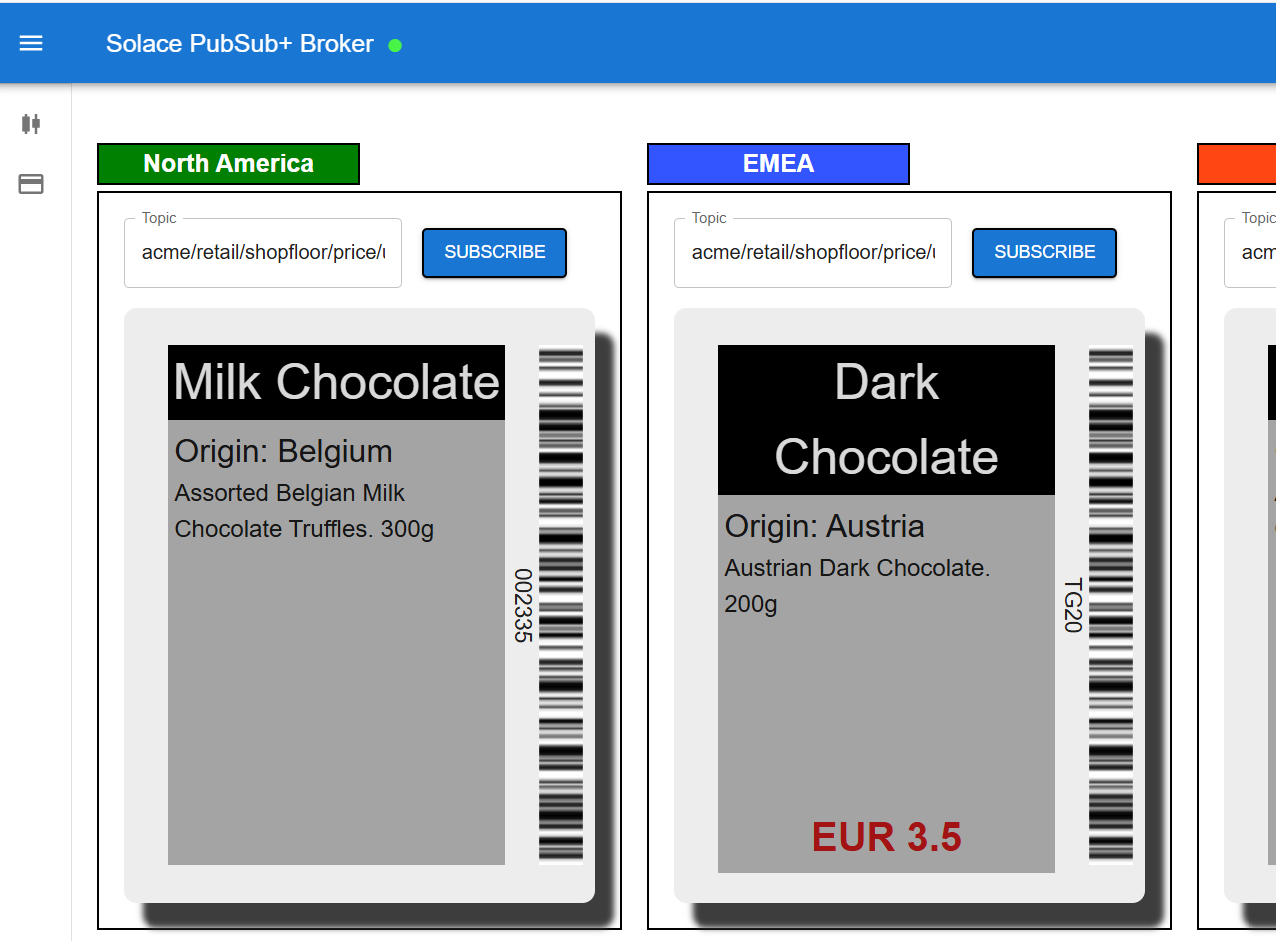
To make the scenario tangible, we used a small web application provided by Solace that simulates the price tags in a store. It connects to the Advanced Event Mesh broker as a subscriber and shows incoming price update events live on screen.
If you want access to this application, reach out to us and we can give you access to the simulator app, which is provided from the Solace team!

After connecting, the demo application subscribes to the topics for the materials we want to track, in this case two retail articles, TG20 and TG21:
acme/retail/shopfloor/price/updated/v1/DE/EMEA/TG21
At this point, the “shelf” is ready and waiting. No events have arrived yet, but the subscription is live. This is an important detail for event-driven architecture: the consumer does not need to poll SAP. It simply waits, and SAP does not need to know who is listening or how many subscribers exist.

Updating the Price in SAP
Now we go to SAP and update the price for material TG20 using transaction MR21. We enter the posting date, company code, and plant, then update the price for the material and save.
This is a completely normal, standard SAP process. No custom coding, no extra steps for the end user. The moment the save happens, the add-on picks up the change in the background and publishes it as an event to the configured topic.

The Event Arrives, Instantly
Switching back to the demo application, the price update event for TG20 appears right away.
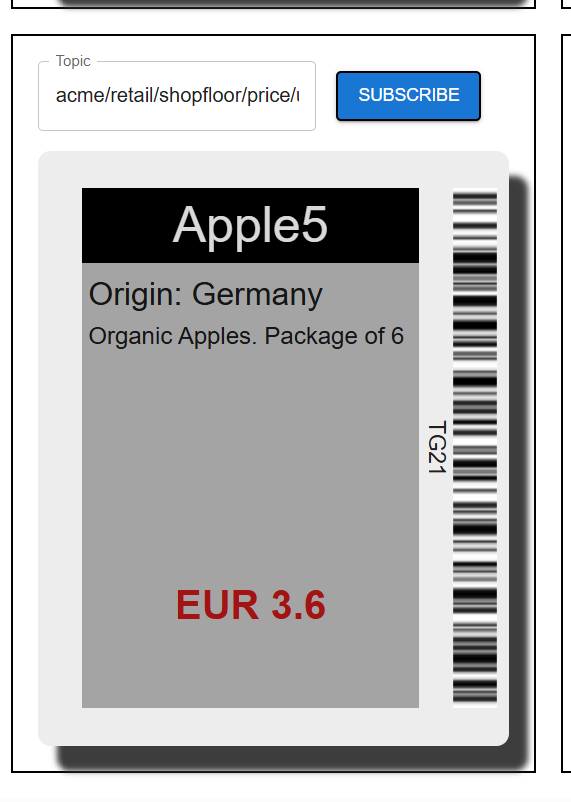
We repeat the same process for material TG21: update the price in MR21, save, and watch the event arrive at the subscriber.
There is no delay between the SAP save and the event showing up. This is the core of the demo: a price change in SAP becomes a real-time signal in the store, without any manual step in between.
Why This Matters: The Value of Event-Driven Architecture
This small demo shows several core benefits of EDA very clearly:
1. Real-time by design, not by extra effort
The event is published the moment the change happens in SAP. There is no polling, no scheduled job, no delay caused by batch windows.
2. Decoupling of producer and consumer
SAP does not know or care who is listening to the events. It just publishes to a topic. Today the subscriber is a demo price tag application. Tomorrow it could be a store analytics dashboard, a mobile app for store staff, or a third-party pricing service, all without touching the SAP side again.
3. Selective consumption through topics
Because the topic includes country, region, and product information, subscribers can pick exactly the slice of events they need. A store in Germany does not need to receive events for a store in another country.
4. Scalability
Adding new subscribers, or new stores, does not add load to SAP. The event broker handles distribution, not the ERP system.
5. A natural fit for retail
Retail is full of scenarios where the shop floor needs to react quickly to changes in the backend: prices, stock levels, promotions, recalls. This demo uses price updates, but the same pattern applies to many other use cases.
Result
Price updates performed in SAP are published as events to the event broker. The demo application receives these events through its topic subscriptions and displays them in real time. When a price is updated in the SAP system, the corresponding event is published immediately, and any subscriber can see the change as it happens.
This is a simple demo, using only two materials and a small web app. But it makes a strong point: with the ASAPIO Integration Add-on / Event Add-on for ERP and an event broker like SAP Advanced Event Mesh, SAP data does not need to sit still until the next batch job. It can move the moment something changes, straight to wherever it is needed.
If you want access to the demo application from the Solace team or would like to talk about how to apply this scenario to your enterprise, do not hesitate to reach out to us directly.